
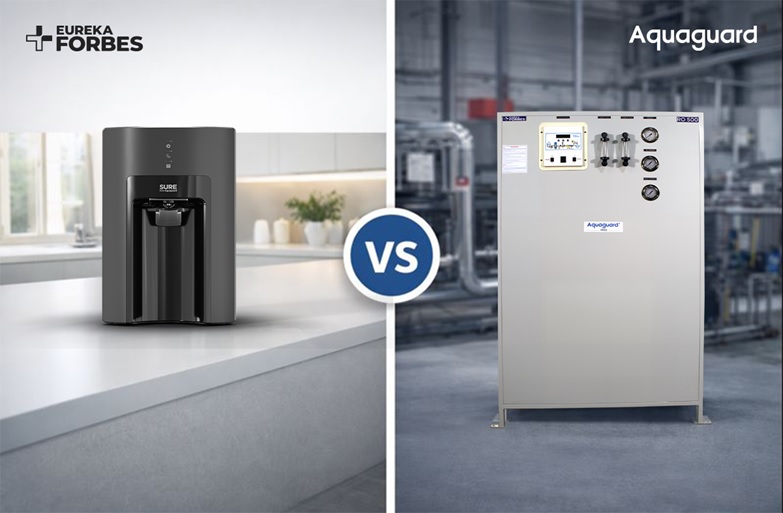
The amount of water you require and how frequently it will be utilised determine which water purifying system is best for you. Although many individuals are familiar with household water purifiers, companies have somewhat distinct needs. Systems that can manage great demand, operate constantly, and provide safe water without interruption are necessary in offices, factories, hospitals, schools, and public areas. A commercial water purifier becomes crucial in this situation.
Understanding how domestic RO purifiers differ from commercial RO water purifiers helps users choose the right system based on scale, usage, and performance needs.
Basic Difference in Usage and Capacity
Capacity is the primary distinction between commercial and home systems. A home RO unit is often used by a household and is intended for limited daily use. It generates tiny amounts of water, which it frequently holds in a tank.
A commercial water purifier, on the other hand, is built for high-volume demand. It supplies water to many people throughout the day without slowing down. These systems are made to run for long hours and handle peak usage without affecting water quality or pressure.
- Design and Build Quality
Domestic purifiers are compact and lightweight, meant to fit under kitchen counters or on walls. Commercial systems are much more robust. They use industrial-grade components, stronger membranes, and durable outer bodies to withstand constant use.
Additionally, a lot of commercial water purifiers have heavy-duty compressors, sophisticated safety measures, and stainless steel construction. This guarantees cleanliness, a long lifespan, and steady performance even in harsh conditions.
- Purification Technology and Performance
Basic RO and UV filtering are typically used in home RO systems. To handle different water conditions, commercial systems employ multi-stage purification, which may include RO, UV, copper infusion, and advanced filters.
To guarantee that water is safe until it is distributed, they also provide end-point filtration, increased water recovery, and self-cleaning functions. These characteristics are particularly crucial in areas where water consumption is constant.
- Storage vs Continuous Supply
Most domestic units store purified water in small tanks. This storage-based approach works well for household consumption, where water demand is predictable and limited. Commercial setups often work without storage tanks or with large integrated systems. This allows water to be purified and supplied in real time.
For businesses where constant water availability is critical, tankless or continuous-flow systems are more practical and hygienic.
- Understanding Domestic vs Commercial RO Water Purifier Price
When comparing systems, the water purifier price depends on capacity, purification stages, automation level, and build quality. Domestic systems are affordable but limited. Commercial water purifiers cost more upfront but offer better long-term value through durability, efficiency, and lower downtime.
For businesses, the focus should be on reliability and output rather than initial price alone.
Commercial Water Purifiers by Aquaguard
These product examples highlight how commercial RO systems are designed differently from domestic units to handle higher demand and continuous operation.
- Aquaguard Prima 100-B Commercial Water Purifier
Designed for heavy-duty use, this system delivers 100 litres per hour with advanced 7-stage RO purification. It operates without a storage tank, making it ideal for places that need a continuous water supply. The self-cleaning system reduces maintenance, improves hygiene, and extends membrane life. With high RO recovery and end-point purification, it is well-suited for institutions with steady, high demand.
- Aquaguard Reviva 50 LPH Storage Commercial Water Purifier
Made for commercial spaces that need both reliability and storage, this system delivers up to 50 litres per hour with advanced 6-stage RO purification. It features a 50-litre inbuilt food-grade storage tank, ensuring continuous access to safe water even during power cuts. The self-cleaning system helps maintain hygiene and extends membrane life, while its compact, durable design makes it suitable for offices, schools, small factories, and institutional kitchens with steady daily demand.
Which Water Purifier System Makes Sense for Businesses?
A commercial water purifier is designed to meet higher demand, offer better hygiene, and reduce operational issues. Whether you need purified water for drinking, cooling, or continuous usage, commercial water purifier systems provide the reliability and performance businesses depend on.
Final Thoughts
The difference between domestic water purifiers and commercial water filters lies in scale, strength, and consistency. While home units serve families well, businesses need solutions built for volume and durability. Investing in the right commercial system ensures safe water, smooth operations, and long-term peace of mind.